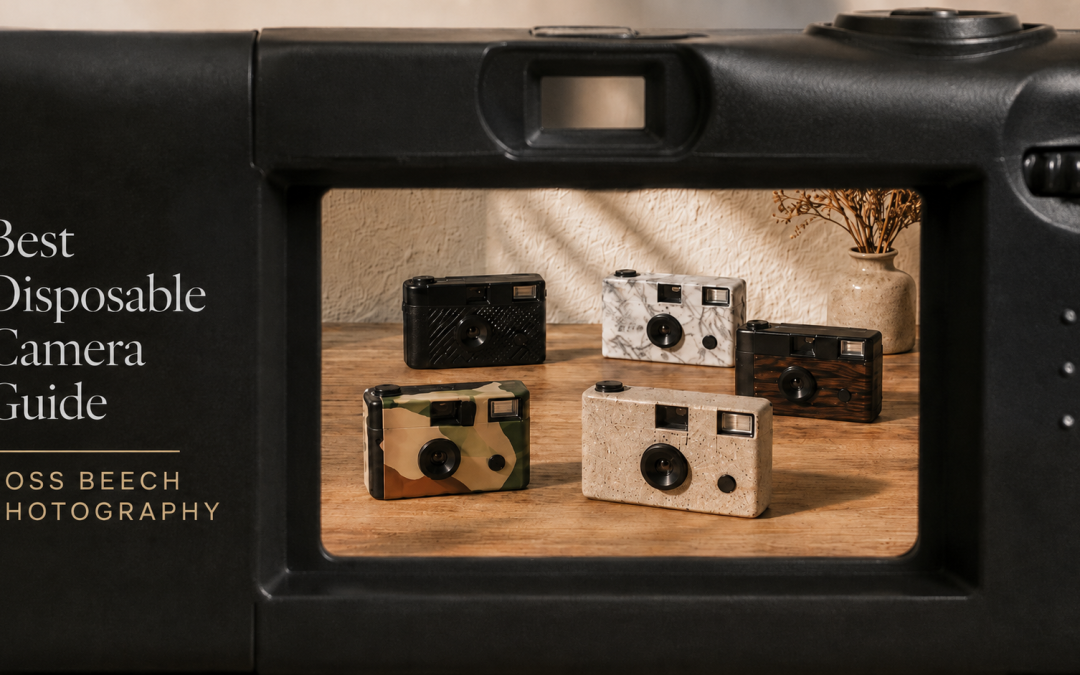
This best disposable camera guide compares the leading options for UK buyers, including cameras for weddings, holidays, parties and black-and-white photography.
This buying guide contains Amazon affiliate links. I may earn a commission from qualifying purchases, at no additional cost to you. As an Amazon Associate I earn from qualifying purchases.
The best disposable camera for most UK buyers is the Kodak FunSaver. Its ISO 800 film makes it more flexible than many ISO 400 alternatives, especially when the light is less than perfect.
The Fujifilm QuickSnap Flash 400 is the strongest colour alternative. Meanwhile, the Ilford XP2 Super is a convenient black-and-white choice because it can use standard C-41 processing.
This guide compares the leading disposable cameras, explains their limitations and calculates the real cost per photograph.
Quick Recommendations
- Best overall: Kodak FunSaver
- Best colour alternative: Fujifilm QuickSnap Flash 400
- Best black and white: Ilford XP2 Super
- Best flash controls: Agfa LeBox 400
- Best for wet conditions: Fujifilm QuickSnap Waterproof
Check the Kodak FunSaver price on Amazon
Who Should Buy a Disposable Camera?
A disposable camera may suit you when you want:
- simple photography without complicated settings;
- informal wedding or party photographs;
- a camera that guests can use easily;
- the distinctive appearance of colour film;
- a break from taking every photograph on a phone;
- an affordable way to experiment with film photography.
However, a reusable film camera is usually the better choice for regular use. It provides more control and creates less waste over time.
How This Guide Was Researched
This guide combines manufacturer specifications with findings from independent hands-on comparisons by experienced photographers and established photography publications.
I have not personally tested every camera included here. My recommendations are based on published testing, technical specifications, processing convenience and suitability for UK buyers.
Prices, stock and specifications can change. Check the exact exposure count, film speed, flash type and seller before ordering.
Prices and specifications last checked: July 2026.
Best Disposable Cameras at a Glance
| Camera | Best for | Film | Flash | Verdict |
|---|---|---|---|---|
| Kodak FunSaver | Best overall | ISO 800 colour | Yes | Most flexible all-round choice |
| Fujifilm QuickSnap Flash 400 | Best colour alternative | ISO 400 colour | Yes | Strong option in good daylight |
| Ilford XP2 Super | Black and white | C-41 black and white | Yes | Convenient monochrome processing |
| Agfa LeBox 400 | Parties and events | ISO 400 colour | Yes | Practical flash controls |
| Fujifilm QuickSnap Waterproof | Wet conditions | Colour | No | Specialist waterproof option |
| Kodak Tri-X or Ilford HP5 Plus | Traditional black and white | Traditional B&W | Yes | Stronger contrast but specialist processing |
Product names, packaging and specifications can change. Check that the Amazon listing matches the exact camera described in this guide.
Compare disposable cameras on Amazon
1. Kodak FunSaver: Best Disposable Camera Overall
The Kodak FunSaver is my strongest all-round recommendation.
It normally contains ISO 800 colour film. Therefore, it has an advantage over many ISO 400 disposable cameras when the light is less than ideal.
It will not produce clean photographs in complete darkness. Nevertheless, it has a better chance of delivering usable results in:
- overcast weather;
- outdoor shade;
- indoor scenes with flash;
- mixed lighting;
- evening events at close range.
What Do Kodak FunSaver Photographs Look Like?
Typical results include:
- warm colours;
- visible film grain;
- slightly soft detail;
- pleasing daylight contrast;
- a familiar Kodak-film appearance.
The plastic lens cannot match the sharpness of a modern digital camera or a quality reusable film camera. However, many people choose disposable cameras because they prefer that softer and less polished appearance.
Kodak FunSaver Handling
The camera includes:
- a thumb wheel for advancing the film;
- an exposure counter;
- a built-in flash;
- a simple viewfinder;
- a clear shutter button.
You need to activate or charge the flash before taking a photograph. This can slow down consecutive shots, although the controls remain simple enough for beginners and wedding guests.
Reasons to Buy
- Flexible ISO 800 film
- Warm and nostalgic colour
- Straightforward operation
- Good general availability
- Suitable for weddings, holidays and parties
Reasons to Avoid
- Flash operation is not instant
- Photographs can look soft
- Very poor light can still cause underexposure
- Developing and scanning increase the total cost
Check the Kodak FunSaver price on Amazon
2. Fujifilm QuickSnap Flash 400: Best Colour Alternative
The Fujifilm QuickSnap Flash 400 is the closest mainstream alternative to the Kodak FunSaver.
It contains ISO 400 colour film. Therefore, it normally requires more light than the Kodak. In bright or lightly overcast conditions, however, it can produce attractive colour and contrast.
The current UK QuickSnap contains 27 exposures of ISO 400 film. It also has a fixed-focus 32mm f/10 lens and a built-in flash with a stated range of approximately one to three metres.
View the official Fujifilm QuickSnap specifications
What Do Fujifilm QuickSnap Photographs Look Like?
Typical characteristics include:
- cooler colour than Kodak;
- stronger blues and greens;
- good daylight contrast;
- visible film character;
- slightly soft detail.
Artificial lighting may affect the colours. Fluorescent lighting can create a green tint, while warm household lighting may produce a yellow cast.
Fujifilm QuickSnap Flash
The QuickSnap has a switch that can activate continuous flash. This can be helpful at parties because you do not need to reactivate the flash before every photograph.
Avoid standing extremely close to the subject. A small built-in flash can make nearby faces appear pale or overexposed.
Reasons to Buy
- Attractive daylight colour
- Convenient flash control
- Lightweight construction
- Established film manufacturer
- Easy for beginners to understand
Reasons to Avoid
- ISO 400 is less flexible in weak light
- Artificial lighting may affect colour
- Flash can look harsh at close range
- Fixed focus limits close-up photography
Check the Fujifilm QuickSnap price on Amazon
Kodak FunSaver vs Fujifilm QuickSnap
These are the two disposable cameras that most buyers are likely to compare.
| Feature | Kodak FunSaver | Fujifilm QuickSnap Flash 400 |
|---|---|---|
| Film speed | ISO 800 | ISO 400 |
| Colour style | Warmer | Cooler |
| Changing light | More flexible | Better in good daylight |
| Flash control | Activated before use | Continuous-flash switch |
| Best use | Events and mixed conditions | Holidays and outdoor use |
| Overall position | Best overall | Best alternative |
Choose the Kodak FunSaver when you want the more forgiving general-purpose option.
Choose the Fujifilm QuickSnap Flash 400 when you expect good daylight and prefer cooler colours.
Neither camera provides manual focusing or exposure control. In addition, the viewfinder does not show the exact frame captured by the lens.
3. Ilford XP2 Super: Best Black-and-White Disposable Camera
The Ilford XP2 Super is my preferred black-and-white option for convenient processing.
XP2 is a chromogenic black-and-white film. This means a laboratory can process it using the C-41 chemistry normally used for colour-negative film.
As a result, it is easier to process than many traditional black-and-white films.
What Do Ilford XP2 Photographs Look Like?
You can expect:
- smooth monochrome tones;
- a slightly soft appearance;
- controlled grain;
- moderate contrast;
- attractive portraits in good light.
Traditional films such as Kodak Tri-X and Ilford HP5 Plus may produce stronger contrast and more obvious grain. However, XP2 offers more convenient processing.
Reasons to Buy
- Standard C-41 processing
- Classic monochrome appearance
- Straightforward controls
- Established film manufacturer
- Easier development than traditional black-and-white film
Reasons to Avoid
- Often more expensive than colour disposables
- Softer than some traditional black-and-white films
- Still struggles in weak light
- Development and scanning cost extra
Check the Ilford XP2 price on Amazon
4. Agfa LeBox 400: Best Flash Controls
The Agfa LeBox 400 is an alternative for parties and indoor events.
Its flash switch makes it easy to see whether the flash is active. Therefore, it may reduce missed photographs and accidental flash use.
Reasons to Buy
- Convenient flash switch
- Effective fill flash
- Sturdy construction
- Good contrast
- Suitable for social events
Reasons to Avoid
- ISO 400 is less flexible without flash
- UK availability may vary
- It can cost more than Kodak or Fujifilm
- Some listings may be imports or marketplace products
Only add an Amazon link when you have found the exact Agfa LeBox model from a seller you trust.
Check the Agfa LeBox price on Amazon
5. Fujifilm QuickSnap Waterproof: Best for Wet Conditions
The Fujifilm QuickSnap Waterproof is designed for places where water could damage an ordinary camera.
It may suit:
- beaches;
- swimming pools;
- kayaking;
- canoeing;
- rainy holidays;
- outdoor activities near water.
Important Limitation
This model does not include a flash.
Therefore, it needs strong available light. It is not a dependable choice for deep, dark or cloudy water.
Choose it because you need waterproof protection. Do not choose it because you expect better image quality than a standard disposable camera.
Reasons to Buy
- Waterproof housing
- Durable construction
- Useful for wet activities
- Easy to carry
Reasons to Avoid
- No flash
- Limited performance in weak light
- Underwater results can be unpredictable
- Specialist rather than general-purpose use
Availability is limited, and the exact waterproof model may not always be listed on Amazon UK.
6. Kodak Tri-X and Ilford HP5 Plus: Traditional Black and White
Kodak Tri-X and Ilford HP5 Plus disposable cameras suit photographers who want a stronger traditional black-and-white appearance.
They may provide:
- deeper blacks;
- stronger contrast;
- more obvious grain;
- sharper-looking detail;
- a dramatic monochrome style.
However, these films normally require traditional black-and-white processing. Not every high-street or postal laboratory can process them.
Choose Ilford XP2 When:
- convenient processing matters;
- you prefer smoother tones;
- your laboratory mainly offers C-41 processing.
Choose Tri-X or HP5 Plus When:
- you prefer stronger contrast;
- visible grain is part of the desired appearance;
- specialist processing is available;
- image character matters more than convenience.
Only include links for models that you can confirm are currently available.
Check the Ilford HP5 Plus price on Amazon
Check the Kodak Tri-X price on Amazon
Best Disposable Camera for Weddings
The Kodak FunSaver is my first recommendation for wedding tables.
Its ISO 800 film provides more flexibility as the light changes. In addition, its controls are simple enough for guests who have never used a film camera.
Disposable cameras should complement a professional wedding photographer rather than replace one. Their purpose is to capture informal moments from a guest’s point of view.
Wedding Buying Tips
- Put cameras in visible places.
- Add a small card explaining how to activate the flash.
- Avoid placing every camera in a very dark area.
- Check the package dates before the wedding.
- Include development and scanning in your budget.
- Expect some blurred or poorly framed photographs.
- Compare multipack and individual-camera prices.
- Do not automatically assume that you need one camera per table.
Check disposable-camera multipacks on Amazon
Best Disposable Camera for Holidays
The Kodak FunSaver is the strongest all-round holiday choice because its ISO 800 film suits a wider range of conditions.
The Fujifilm QuickSnap Flash 400 is a good alternative for bright destinations. It may also suit buyers who prefer cooler colours.
Choose a waterproof model only when protection from water is essential.
Where possible, buy the camera before travelling. Film stored for long periods in hot or humid shops may produce inconsistent results.
What Does a Disposable Camera Really Cost?
The purchase price is only part of the total cost.
You may also need to pay for:
- film development;
- digital scans;
- printed photographs;
- return of negatives;
- postage;
- specialist black-and-white processing.
FilmProcessing.co.uk lists separate prices for colour development, digital scans and prints.
Check current disposable-camera processing prices at FilmProcessing.co.uk
Fujifilm QuickSnap Cost Per Photograph
Using an example camera price of £17.99 and processing costs of £5 for development and £4 for standard digital scans:
| Cost | Amount |
|---|---|
| Fujifilm QuickSnap | £17.99 |
| C-41 development | £5.00 |
| Standard digital scans | £4.00 |
| Total before postage | £26.99 |
| Available exposures | 27 |
| Cost per exposure | Approximately £1.00 |
The calculation is:
£26.99 divided by 27 = approximately £1.00 per available photograph.
However, not every photograph will be worth keeping.
For example, suppose the camera produces 18 photographs you like:
£26.99 divided by 18 = approximately £1.50 per keeper.
That calculation gives a more realistic picture of value.
Costs Not Included
The example does not include:
- delivery for the camera;
- postage to the laboratory;
- return postage;
- physical prints;
- premium-resolution scans;
- specialist black-and-white processing.
Prices can change. Update this calculation whenever you check your affiliate links and the processing company’s price list.
Before You Buy a Disposable Camera
Check these details before ordering.
Exposure Count
Most disposable cameras offer 27, 36 or 39 exposures. Check the exact version before buying.
Film Speed
ISO 800 film is generally more flexible than ISO 400. However, neither film speed guarantees good photographs at night.
Flash
Confirm that the camera includes a flash. Some outdoor and waterproof models do not.
Processing Method
Colour film and Ilford XP2 normally use C-41 processing. Traditional black-and-white films may need a specialist laboratory.
Package Date
Buy from a retailer with fresh stock. Check that the date shown on the package is still in the future.
Seller
Choose a trustworthy UK retailer or established Amazon seller. Avoid unclear listings that do not identify the exact camera.
Total Cost
Include the camera, processing, scans, prints and postage in your budget.
How Many Photographs Does a Disposable Camera Take?
Most disposable cameras take around 27 photographs. However, some versions provide 36 or 39 exposures.
Check the product description carefully. Similar-looking versions can contain different film speeds and exposure counts.
A camera with more exposures may offer better value. Nevertheless, you should also compare the purchase price and processing costs.
Do Disposable Cameras Need Flash?
You usually do not need flash outdoors in strong daylight.
Use the flash:
- indoors;
- during the evening;
- in deep shade;
- when the subject is backlit;
- whenever the available light appears weak.
Do not stand too close to the subject. A small flash can overexpose nearby faces.
At the same time, do not stand too far away. Disposable-camera flashes have a limited working range.
Why Do Disposable-Camera Photographs Look Blurry?
Disposable cameras use basic fixed-focus plastic lenses.
Blur can happen because of:
- standing too close;
- camera movement;
- weak light;
- moving subjects;
- fingers covering the lens;
- inaccurate framing;
- a damaged or poorly made camera.
The viewfinder does not show exactly what the lens captures. Therefore, keep your fingers away from the lens and flash.
How Many Photographs Will Turn Out Well?
Do not expect every frame to be successful.
You may lose photographs because of:
- incorrect flash use;
- poor lighting;
- fingers over the lens;
- inaccurate framing;
- subject movement;
- cameras being lost or not returned;
- processing problems.
That uncertainty is part of the experience. However, it also increases the cost per photograph you keep.
Should You Buy an Unbranded Disposable Camera?
Approach unknown brands carefully.
A cheap camera may contain usable film. However, it can be difficult to confirm:
- who made the film;
- how old the film is;
- how it was stored;
- whether the lens is reliable;
- whether the flash works;
- which processing method it requires.
Development and scanning can cost almost as much as the camera. Therefore, saving a few pounds on an unreliable product may be false economy.
For an important event, an established film manufacturer is usually the safer option.
Does It Matter Where You Buy a Disposable Camera?
Yes. Heat, humidity and long storage can affect photographic film.
Choose a retailer that:
- regularly sells film;
- stores products indoors;
- provides accurate product information;
- has good stock turnover;
- supplies a camera with a future package date.
Avoid dusty packaging or cameras that may have been displayed in direct heat.
Are Disposable Cameras Environmentally Friendly?
Disposable cameras create more waste than reusable cameras.
Some manufacturers and laboratories recycle camera bodies or recover components. However, arrangements vary.
A disposable camera may make sense for an occasional wedding or holiday. For regular film photography, a reusable camera is the more sensible long-term choice.
How to Get Better Disposable-Camera Photographs
- Look for good natural light.
- Use the flash indoors.
- Do not stand too close.
- Hold the camera steady.
- Keep your fingers away from the lens.
- Centre important subjects.
- Avoid severe backlighting.
- Wait for the flash to charge.
- Wind the film fully.
- Keep the camera cool and dry.
- Check the package date before an important event.
Frequently Asked Questions
What Is the Best Disposable Camera?
The Kodak FunSaver is the best disposable camera for most buyers. Its ISO 800 film makes it more flexible than many ISO 400 alternatives.
Is Kodak or Fujifilm Better?
Kodak is the more flexible general-purpose choice. Fujifilm is a strong daylight alternative for people who prefer cooler colours.
Which Disposable Camera Is Best in Low Light?
The Kodak FunSaver is the stronger choice because it normally uses ISO 800 film. However, you should still use the flash indoors and after dark.
Which Disposable Camera Has the Best Image Quality?
The Kodak FunSaver and Fujifilm QuickSnap Flash 400 are the safest mainstream colour choices.
Neither provides perfect sharpness because both use fixed settings and simple plastic lenses.
What Is the Best Black-and-White Disposable Camera?
Choose the Ilford XP2 Super when convenient C-41 processing matters.
Choose Kodak Tri-X or Ilford HP5 Plus when you prefer stronger contrast and have access to specialist processing.
What Is the Best Disposable Camera for Weddings?
The Kodak FunSaver is my leading wedding recommendation because it combines ISO 800 film with simple controls.
What Is the Best Waterproof Disposable Camera?
The Fujifilm QuickSnap Waterproof is a specialist option for wet conditions. It does not have a flash and needs strong light.
Can a Disposable Camera Be Reused?
Disposable cameras are not designed for customers to reload.
Some laboratories recycle or reuse components. However, frequent film users should consider a reusable camera.
Final Verdict
The Kodak FunSaver is the best disposable camera for most UK buyers.
Its main advantages include:
- ISO 800 film;
- warm colours;
- straightforward operation;
- a useful built-in flash;
- good general availability;
- greater flexibility in changing light.
The Fujifilm QuickSnap Flash 400 is the strongest colour alternative. It performs best in good daylight and suits buyers who prefer cooler colours.
Meanwhile, the Ilford XP2 Super is the most convenient black-and-white option to process.
Before buying, check the exposure count, film speed, seller and development costs. Most importantly, choose a camera that matches the conditions in which you expect to use it.
Check the Kodak FunSaver price on Amazon
Compare disposable cameras on Amazon
More Photography Guides
Enjoyed this guide? These related articles may also help you improve your photography:
- Exposure Triangle in Photography: A Complete Beginner’s Guide — learn how aperture, ISO and shutter speed work together.
- RAW vs JPEG Photography: What’s the Difference? — understand which image format is best for editing and convenience.
- What Is Shutter Speed in Photography? — learn how shutter speed affects movement, blur and sharpness.
- Landscape Photography Tips: 12 Easy Ways to Improve — practical advice for composition, lighting and sharper landscape photographs.
- Devon Photography Locations Guide — discover scenic photography locations across Devon.
- Browse All Photography Articles — explore more photography guides, reviews and tips.